Succession Planning & Talent Assessment
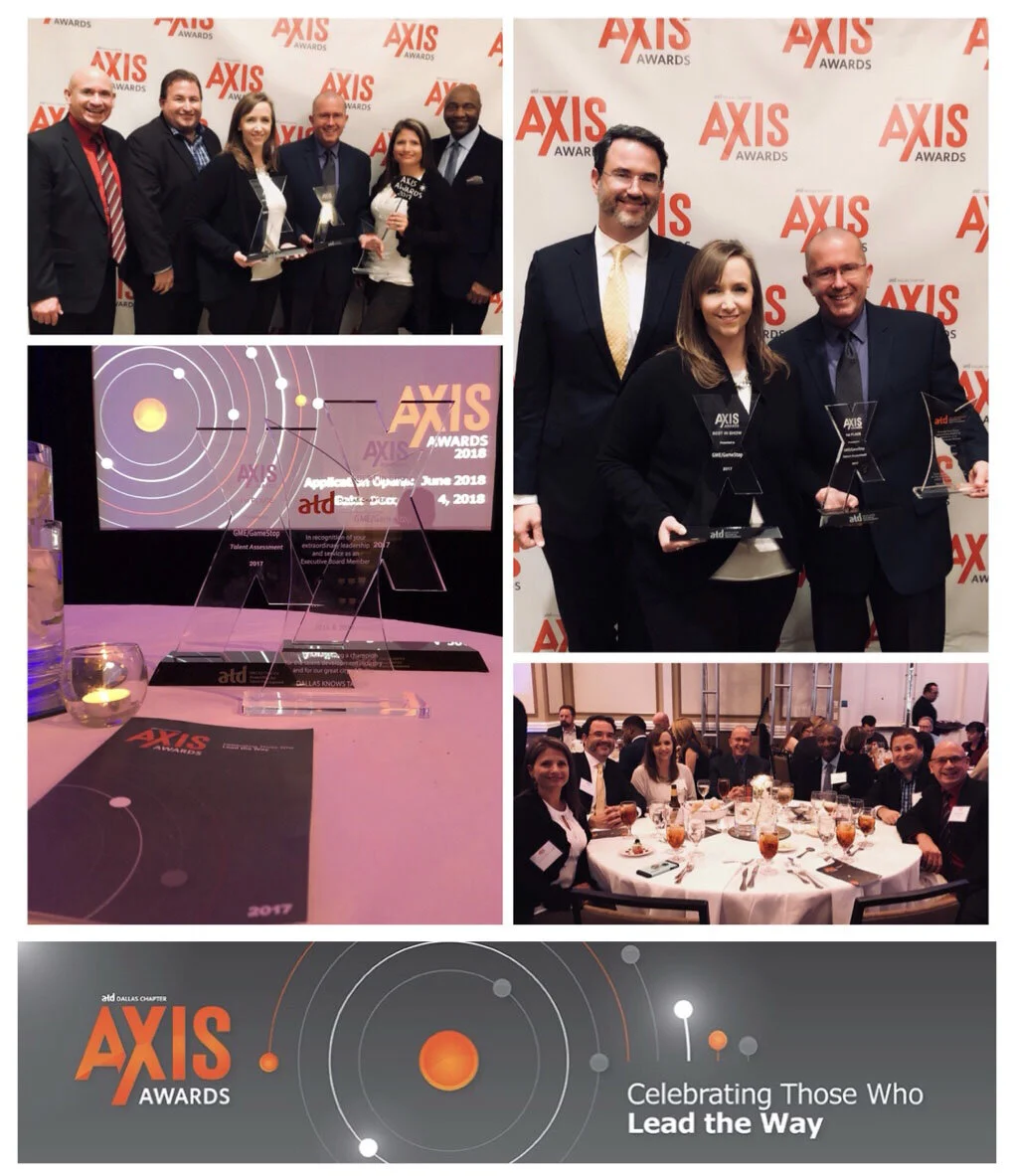
2018 - 2nd Place Winner
GameStop recognized the need to create structured leadership competencies and a sophisticated, actionable assessment methodology to identify and develop leaders suitable for organizational promotional opportunities.
A big part of this initiative was developing a promotion-focused succession planning/talent assessment process for senior levels of leadership based on a desire to be transparent, rigorous, and competency-focused for all promotional decisions. The assessment was designed in response to needs identified collaboratively by leaders at all levels of the organization. The outcome was a multi-day, executive-sponsored assessment that selects and evaluates participants quantitatively and qualitatively, culminating with a calibrated senior executive assessment discussion and a customized development plan for each participant. The program includes a 360 assessment, individual activities to assess business and financial acumen, several team activities requiring collaboration to solve a complex business problem, and a structured interview conducted by the organization's senior leaders.
GameStop’s investment in a robust talent assessment process has allowed the organization to promote more internal leaders into senior-level roles, resulting in reduced enterprise-level operating costs, role redundancies, talent sourcing costs, and higher retention rates for leaders sourced through the process.
Talent Assessment (HIPO Assessments)
2017 - Best in Show & 1st Place Winner
GameStop has grown, evolved, and diversified to include multiple brands operating in more than a dozen countries. This evolution resulted in a need to identify more ‘portable’ leadership talent capable of leading any of its businesses. To meet this need, I designed and introduced a series of calibrated assessments and development interventions to answer four questions regarding the future business landscape, future talent needs, current talent available, and strategies for closing the gap. This approach has been central to its long-term talent planning strategy.
GME’s assessment process focuses on the global competencies identified by senior organizational and OD leaders. During the process, senior executives in the organization observe and assess nearly all assessment activities, including the C-suite and other leading executives. It includes a 360 assessment, individual activities demonstrating financial and operational acumen, and team scenarios involving solving complex business problems under pressure and working with others.
The program's effectiveness is measured continuously with each candidate’s business performance, 9-box placement, retention rate, growth rate, and success in new placements. Post-assessment discussions are conducted to assess progress with individual development plans and business development plans. Finally, the team evaluates how well they can fill omnichannel, multi-brand leadership roles with internal talent. As a result of this program, the team is promoting over 50% of candidates in the assessment process, has minimized sourcing fees for many roles, has increased the speed of opening new stores, and retained talent at a greater rate among program participants.
The High Potential (HIPO) Program continues the leader-served development path concept. Indeed, our development culture is best described as “member-led, leader-served,” which communicates the importance of each person taking charge of his or her career with robust support from their leader. Additionally, such career planning and support focus on the type(s) of work people love to do the most (analytical, creative, operational, entrepreneurial). Such an approach, designed by leaders and their team members and supported by OD, learning, and HR, creates expanded career path opportunities for people. It is also focused entirely on developing people who are producing exceptional results for the organization now and have demonstrated the potential to succeed with larger, more complex responsibilities in the future.
The program puts high-performing leaders in front of the organization’s entire senior leadership team, where they are assessed under constructive pressure. They participate in a targeted interview, solve and present an individual case problem, solve and present a challenging group case problem working collaboratively, and participate in a variety of high-visibility social situations in which we evaluate the degree to which they can solve complex business and relationship challenges while being observed by senior leaders. Every participant receives 360 from a personal coach. The assessment experience culminates in an individual development plan with related resources, coaching support, and regular follow-up from their leader and OD & HR partner.
Performance Improvement (LMS)
2016 - 1st Place Winner
Historically, GameStop operated as a single global brand that provided employees with one career path which relied heavily on capability and opportunity. However, a recent rapid expansion through acquisition resulted in an organization with over eight related gaming, mobile, and entertainment brands — each operating with unique career paths.
GameStop needed to identify one solution that would build a talent pool capable of moving among brands without adding significant costs. LevelUp Interactive 2.0, the organization’s internally developed, proprietary, and innovative gamified learning platform was built as a fully scalable, multi-tenant development program that can be customized and segmented by brand and deployed to any domestic and international brand as needed. It allows employees to train for their current and aspirational levels, encouraging professional growth and building the organization’s talent bench.
Since its introduction, GameStop has used the LevelUp technology to keep its employees focused on the essential elements of its business model, which has helped grow all components of the core business. The organization has experienced a rate of internal promotions above the industry average, customer satisfaction scores in the 90th percentile, and a rate of employee turnover below the industry average. Moreover, it has been able to use the tool to correlate business metrics with learning completion data to customize learning to continually meet the greatest business need.